


Copyright © 2025 Greenster


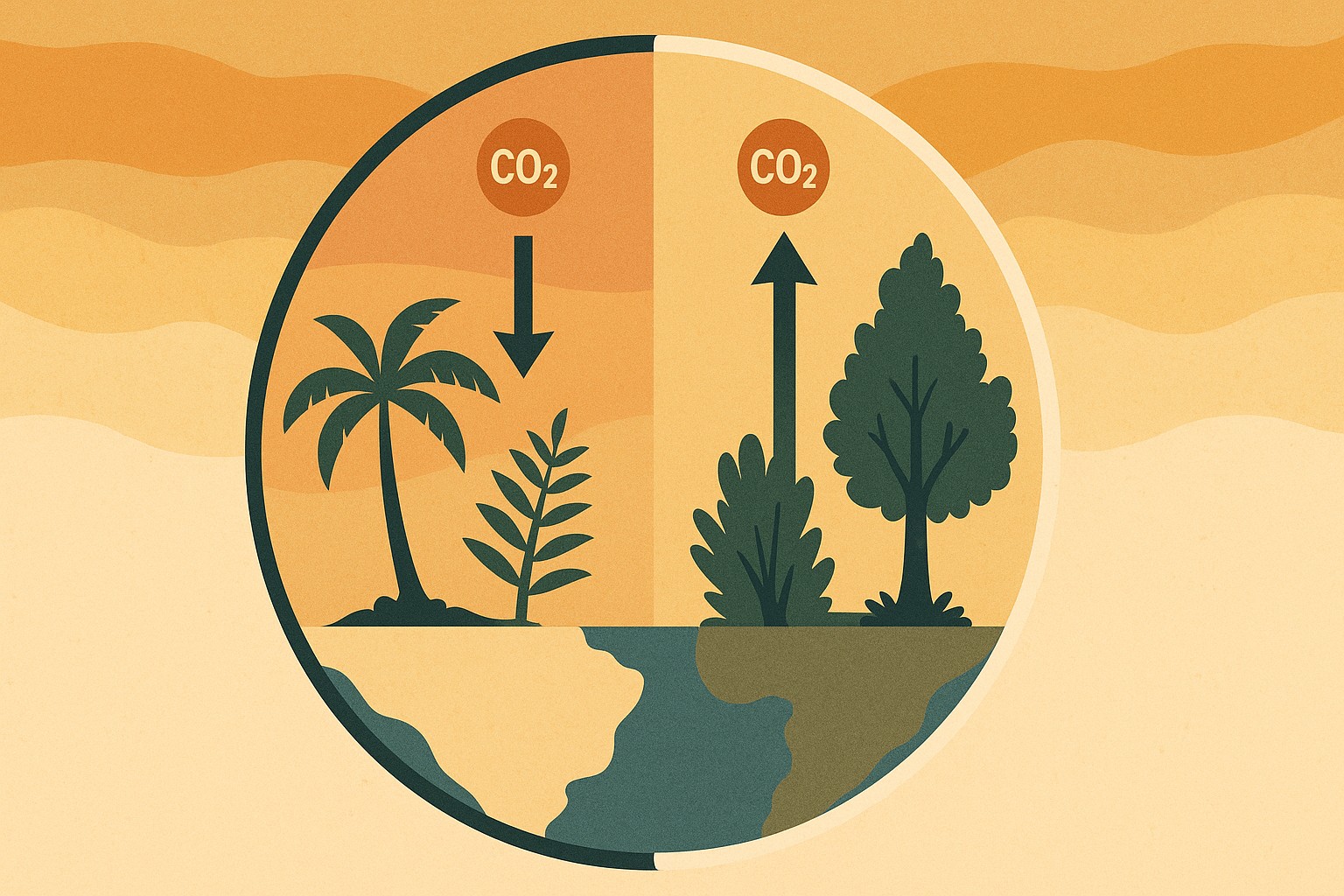

About 56 million years ago, global temperatures spiked by roughly 6°C in just a few thousand years. The atmosphere filled with carbon, the planet heated rapidly, and something unexpected happened: plants began to fail.
According to new research published in Nature Communications, this breakdown in plant function triggered a chain reaction. As many species struggled to grow, Earth’s natural ability to absorb carbon weakened — and the warming event dragged on for more than 100,000 years.
Today, human-driven warming is happening ten times faster than during this ancient heatwave. The past may be telling us something about our future.

Plants normally help stabilize the climate by absorbing CO₂ through photosynthesis and storing it in leaves, wood, and soils. But during a major rapid-warming event known as the Paleocene–Eocene Thermal Maximum (PETM), that natural system faltered.
To understand how vegetation responded, researchers built a detailed computer model of plant evolution and carbon cycling. They paired the results with fossil pollen and plant-trait data from three regions: the Bighorn Basin in the U.S., the North Sea, and the Arctic Circle.
Why pollen? It’s ideal for reconstructing ancient ecosystems. Plants produce it in huge quantities, it travels far, and its tough outer shell preserves it beautifully for millions of years. This allowed researchers to track shifts in plant size, leaf thickness, and the rise or decline of deciduous species as Earth rapidly warmed.
Across mid-latitude regions like the Bighorn Basin, the fossil record revealed a dramatic shift. Large trees declined. Smaller, drought-tolerant plants such as palms and ferns took over. Leaf mass per area — a sign of thicker, tougher leaves — increased. Soils held less carbon, suggesting vegetation wasn’t storing much anymore.
These hardy plants could survive rapid warming, but they weren’t great at locking away CO₂, reducing the land’s ability to regulate the climate.
Higher latitudes told a different story. In the Arctic, vegetation actually grew taller and denser. Conifer forests gave way to broad-leaved swamp species, with some subtropical plants persisting as temperatures rose. Here, warming boosted plant productivity and carbon storage — a rare bright spot in an otherwise stressed global system.
During the PETM, the loss of efficient, carbon-storing vegetation in many regions likely weakened Earth’s natural carbon sink for 70,000–100,000 years. The result: the warming event lasted far longer than it otherwise might have.
The research suggests that once vegetation collapses in response to rapid warming, it takes a long time for climate-regulating ecosystems to recover.
And that’s the warning for today. During the PETM, warming of 4°C or more pushed mid-latitude plants past their limits. Modern climate change is happening much faster, giving plants less time to adapt, migrate, or evolve. Understanding how ancient ecosystems responded helps us see the pressure modern forests, grasslands, and soils may face in the decades ahead.
Stay in the loop
Stay
0 Comments