


Copyright © 2025 Greenster


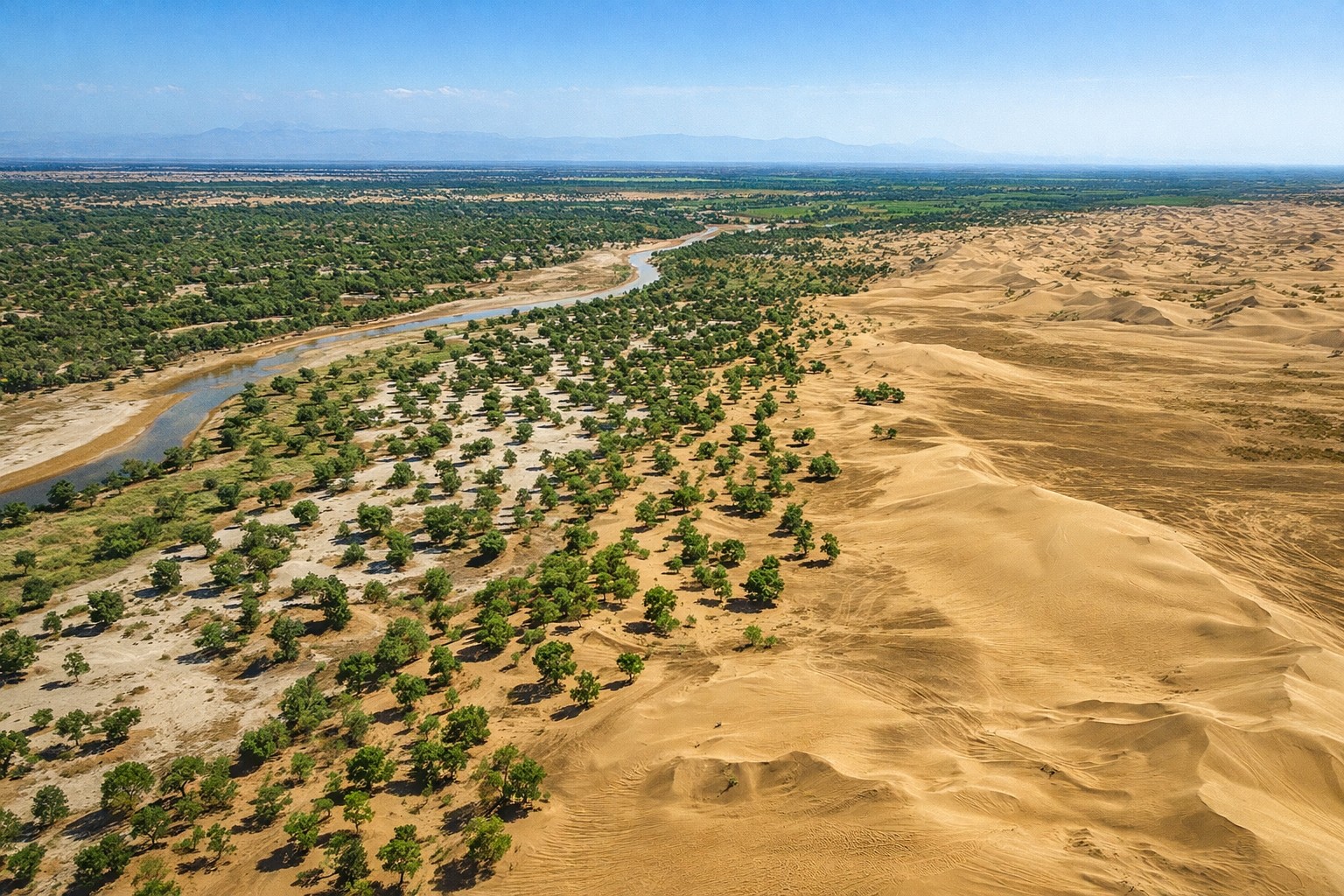

For decades, the Taklamakan Desert was seen as one of the harshest places on Earth - a vast “biological void” where more than 95% of the land is covered in shifting sand. Slightly larger than the U.S. state of Montana and surrounded by high mountains that block most moisture, the desert is so dry that very few plants can survive there. But according to a new peer-reviewed study published in Proceedings of the National Academy of Sciences, decades of large-scale tree planting around the desert’s edges may now be changing that. Researchers found that vegetation growing along the Taklamakan’s rim is absorbing more carbon dioxide (CO2) than the desert releases.

The shift is tied to China’s massive tree-planting effort known as the Three-North Shelterbelt Program, often called the “Great Green Wall.” Launched in 1978, the project aims to slow the spread of deserts by planting billions of trees around northern China. More than 66 billion trees have been planted so far. In 2024, China completed a continuous green belt around the Taklamakan Desert. Forest cover across the country has grown from about 10% of China’s land area in 1949 to more than 25% today. Researchers say the growing vegetation has also helped stabilize sand dunes along the desert’s edges.
To understand what impact this has had, scientists analyzed 25 years of satellite data and ground observations. They studied rainfall, plant growth, photosynthesis, and CO2 movement in and out of the desert. They also used data from the National Oceanic and Atmospheric Administration’s Carbon Tracker, which models carbon sources and sinks around the world. The results show a clear trend: as vegetation expanded along the desert’s edges, carbon uptake increased in the same areas. During the July to September wet season, rainfall averages about 0.6 inches (16 millimeters) per month - roughly 2.5 times more than during the dry season. That added moisture boosts plant growth and photosynthesis, lowering CO2 levels over the desert from 416 parts per million in the dry season to 413 parts per million in the wet season.
Earlier research suggested the Taklamakan might act as a carbon sink because its sand can absorb CO2. But scientists also found that this process may not be stable as temperatures rise, since warming can cause the sand to release stored carbon back into the air. The new study focuses instead on the vegetation planted along the desert’s rim. Based on their findings, researchers say this marks the first successful example of turning part of a desert into a carbon sink through large-scale human effort. While it remains unclear how much the tree belt has reduced sandstorms, the study suggests the project could serve as a model for other desert regions looking to slow land degradation and increase carbon absorption.
Stay in the loop
Stay
0 Comments